
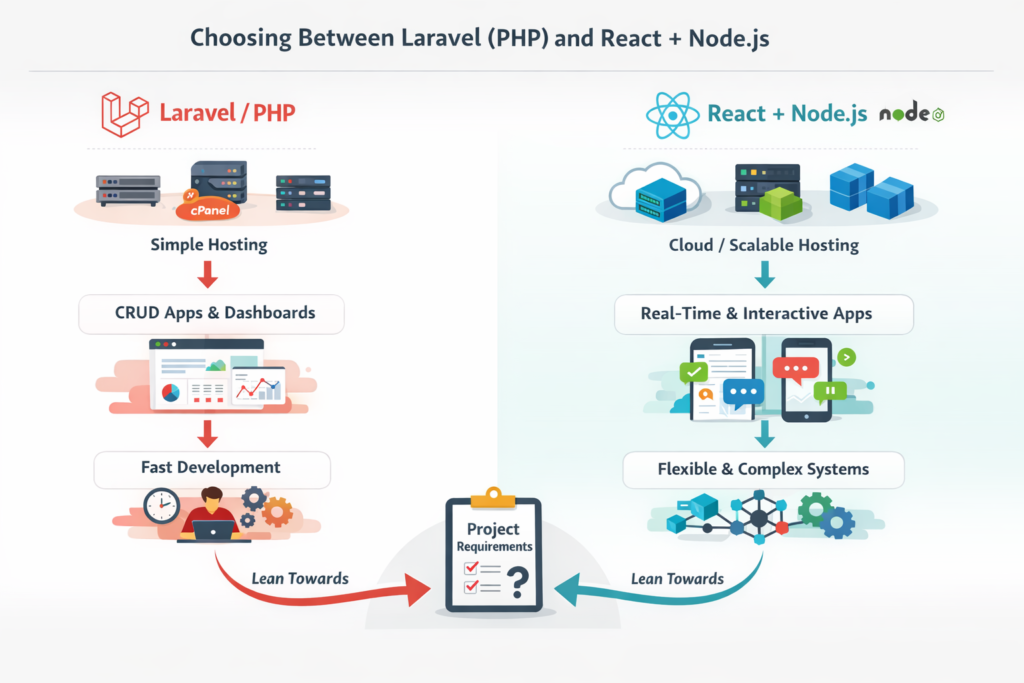
How We Decide Between Laravel (PHP) and React + Node.js for a New Project
Whenever we start a new project, one of the first questions that comes up is:
Which technology stack should we use?
Usually the discussion ends up somewhere between two popular options:
- Laravel / PHP
- React + Node.js
Both are great technologies, and both can build powerful systems. But instead of following trends or personal preferences, we usually look at a few practical factors that help narrow things down.
Over time, this simple approach has helped us pick the right stack for most projects.
Here’s roughly how we think about it.
First Thing We Look At: Where Will It Be Hosted?
This might sound boring, but hosting actually influences the technology choice a lot.
If a project is going to run on something like:
- shared hosting
- cPanel hosting
- a basic VPS
then Laravel / PHP usually becomes the easiest and most practical option.
PHP runs almost everywhere without extra configuration. Deployment is simple, and the infrastructure is easy to maintain.
On the other hand, if the project is planned for environments like:
- AWS
- container infrastructure
- cloud platforms
- scalable VPS clusters
then Node.js starts to make more sense, especially if we expect the system to grow over time.
So hosting is often the first filter that helps narrow down the options.
Next Question: What Kind of Application Is This?
The second thing we try to understand is the nature of the system itself.
A lot of projects we build are mostly about:
- storing data
- dashboards
- admin panels
- reports
- business workflows
- CRUD operations
For these types of systems, Laravel is extremely productive. It already includes many things that we would otherwise need to build from scratch.
On the other hand, some applications are much more interactive.
For example:
- real-time dashboards
- live updates
- collaboration tools
- very dynamic frontends
In those cases, React with a Node.js backend can be a better fit because it gives much more flexibility on the frontend side.
Development Speed Also Matters
Sometimes the goal is simply to build something reliable and launch quickly.
Laravel is fantastic for that.
It already includes things like:
- authentication
- database models
- validation
- queue systems
- email handling
- structured architecture
This means we can focus more on the actual product logic instead of assembling many tools.
React + Node ecosystems are very powerful, but they often involve combining multiple libraries and tools together. That flexibility is great for large systems, but it can slow things down for smaller projects.
So we often ask ourselves:
Which stack will help us build this system faster without making things complicated?
Another Thing We Consider: Maintenance
Technology decisions are not only about building the system — they are also about maintaining it later.
Laravel applications are usually quite simple to manage. A typical setup just needs:
- a web server
- PHP runtime
- a database
Node applications can introduce a few additional moving parts like:
- process managers
- runtime monitoring
- container setups in larger deployments
None of this is bad, but it does add some operational overhead, so we try to factor that in while choosing the stack.
What About Scalability?
A common assumption is that one stack automatically scales better than another.
In practice, we’ve found that architecture matters far more than the language itself.
Both Laravel and Node applications can scale very well with the right setup:
- caching
- load balancing
- background jobs
- database optimization
So instead of focusing only on the technology, we spend more time thinking about how the system will be structured.
SEO Can Also Influence the Choice
For projects where search engine traffic is important, things like server-side rendering become relevant.
Laravel naturally renders pages on the server, which works nicely for:
- marketing websites
- content platforms
- SEO-focused pages
React applications can do the same with tools like Next.js, but that introduces a bit more infrastructure complexity.
So if SEO plays a big role, that can influence the direction as well.
The Simple Way We Usually Narrow It Down
After looking at these factors, the decision often becomes pretty clear.
We usually lean toward Laravel / PHP when:
- the system is mostly database-driven
- development speed is important
- hosting is simple
- SEO pages are involved
- the project includes dashboards or admin panels
We usually lean toward React + Node when:
- the frontend is highly interactive
- real-time updates are required
- the product behaves more like an application than a website
- cloud-native architecture is planned
In the End, It’s About Choosing the Right Tool
There is no universal “best stack”.
Both Laravel and React/Node are excellent technologies.
The important thing is simply choosing the one that fits the project best — the infrastructure, the team, and the long-term goals.
At TechMatrix, we try to keep the decision process simple and practical.
Because most of the time, the best technology choice is not the most fashionable one…
it’s the one that makes the project easier to build, run, and maintain.